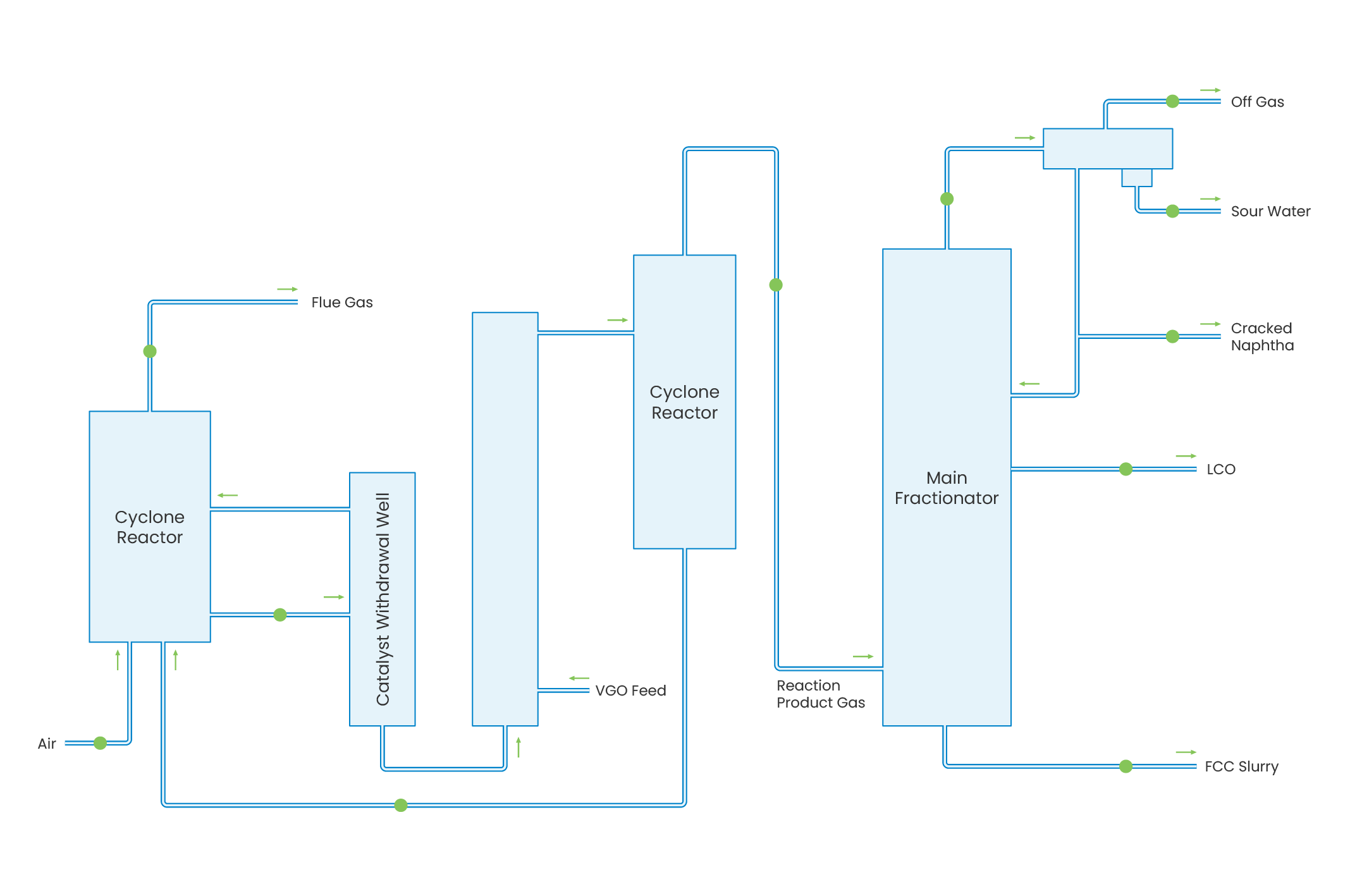
The Fluidised Catalytic Cracking (FCC) unit cracks heavier hydrocarbons into lighter transport fuels. Carbon, in the form of coke, lays down on the zeolite catalyst used in the unit and rapidly deactivates the catalyst. To mitigate this, the catalyst is kept in a fluidised state which allows it to be transported to the regenerator, in which the coke is burnt off the catalyst using air, and the catalyst is then returned to the riser. The reaction products disengage from the catalyst via cyclones at the top of the reactor vessel. The reactions in FCC units are endothermic but heat balance operation is maintained using the heat of the coke that is combusted in the Regenerator. The products from an FCC are high in aromatics and unsaturated olefins. As a result, FCC units tend to have lower diesel and higher gasoline yields than hydrocrackers. Product qualities also tend to be better for the gasoline products (cracked naphtha) than the diesel range material (light cycle oil). LPG olefins can be used to make alkylate.
The main fractionator produces fuel gas, LPG, a heavy naphtha cut, light cycle oil (LCO) and FCC Slurry. A slurry backwash filter system can also be provided.
The key to treating FCC gasoline is in the ability to achieve the required sulphur reduction whilst maintaining octane levels.
top
Inactive
Tailored analytical solutions
for Southeast Asia’s industries.
Inactive
Solving analytical challenges
in every industry,
every day.