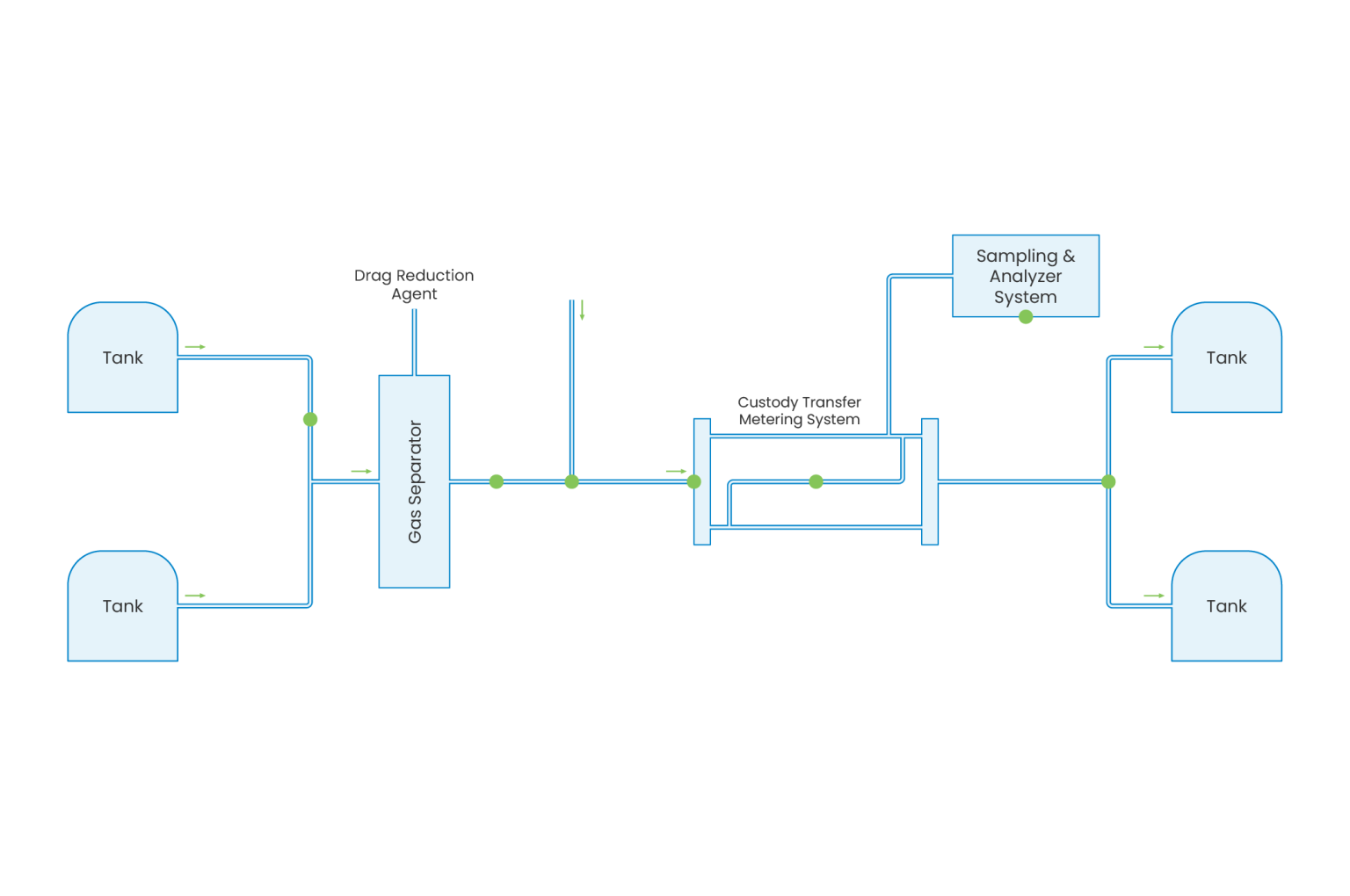
Crude oil and refined product pipeline systems transport liquid hydrocarbons between storage terminals, refineries, blending facilities, and distribution hubs. Product is withdrawn from storage tanks using transfer pumps and routed through a gas separator to remove entrained gas and stabilize the liquid stream. In long-distance transmission pipelines, drag reduction agents may be injected to lower friction losses and improve hydraulic efficiency.
The product then passes through pump stations that provide the required pressure to move the liquid along the pipeline network. A custody transfer metering system, including master meters and provers, ensures accurate measurement of flow for commercial transactions and regulatory compliance. Before entering receiving storage tanks or downstream facilities, the product flows through a sampling and analyzer system to verify key quality parameters such as density, composition, sulfur, or water content, confirming that product specifications are met. Continuous monitoring throughout the pipeline network supports safe operation, product integrity, and efficient transportation of crude oil and refined products.
top
Inactive
Tailored analytical solutions
for Southeast Asia’s industries.
Inactive
Solving analytical challenges
in every industry,
every day.