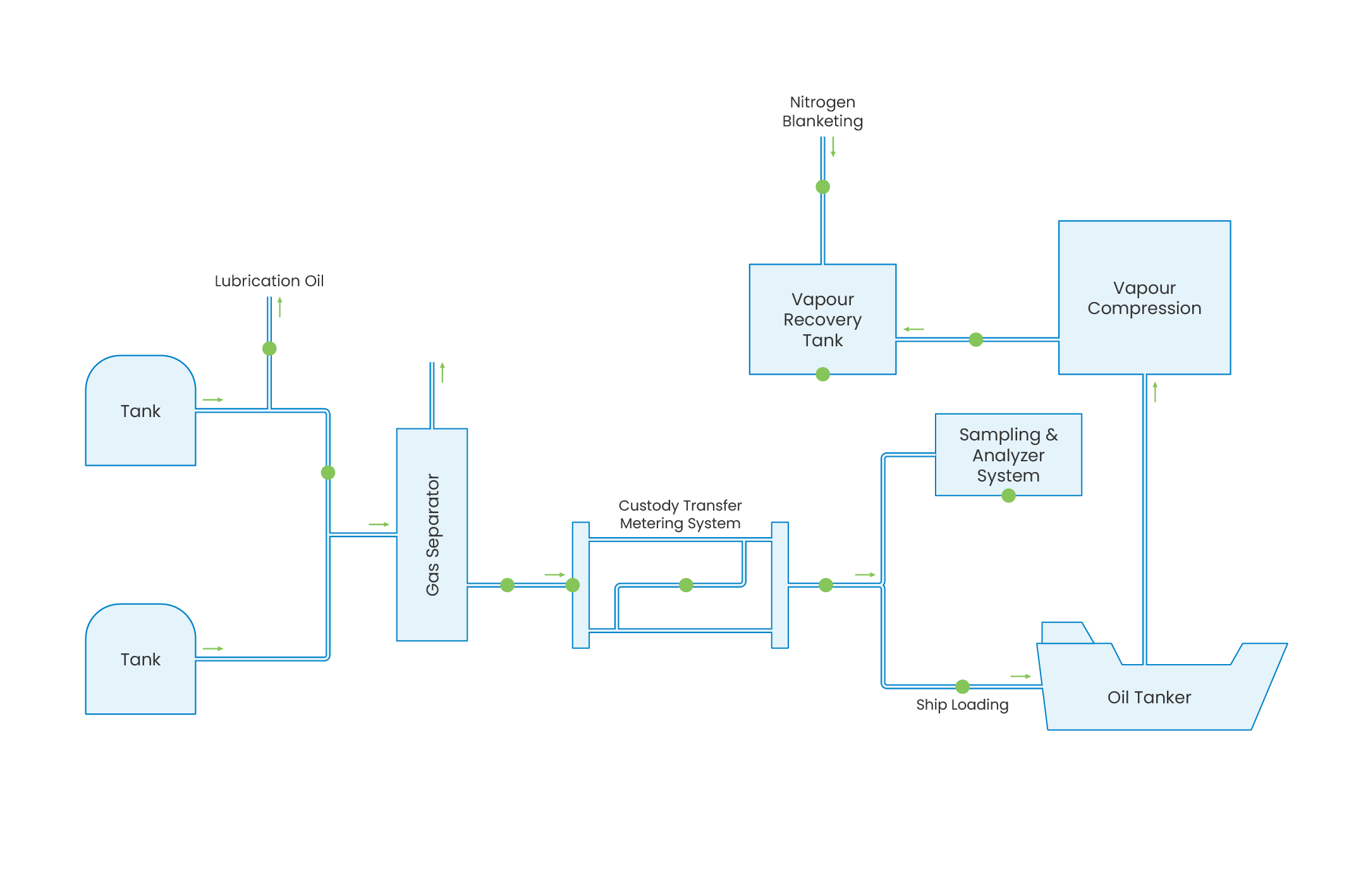
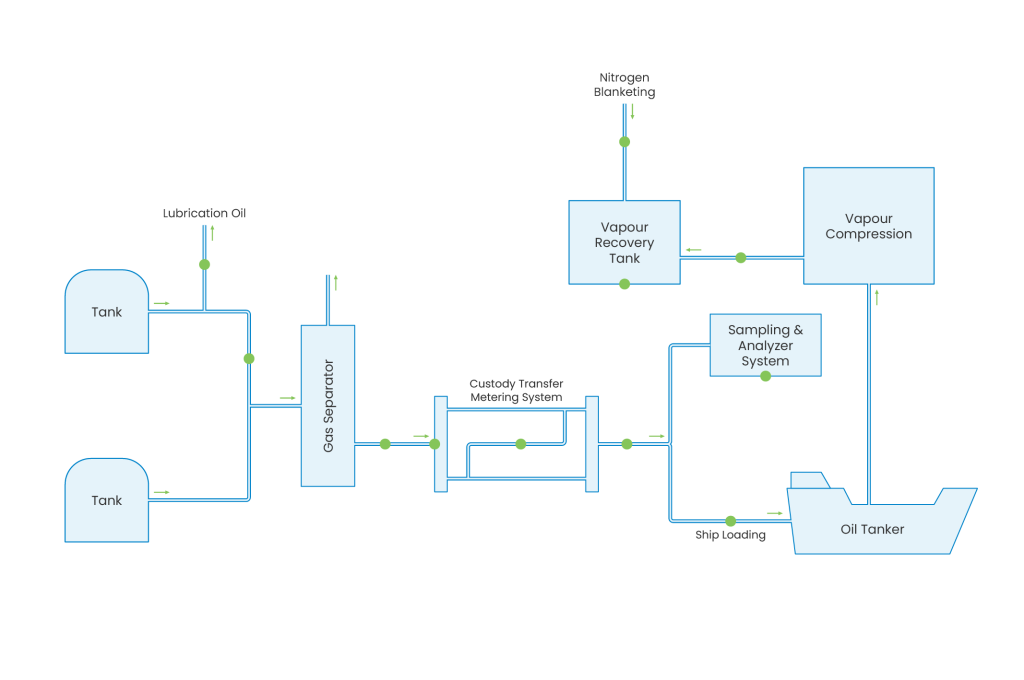
Ship loading facilities transfer liquid hydrocarbons from storage tanks to marine tankers for export or large-scale distribution. Product is withdrawn from one or multiple storage tanks using transfer pumps and routed through a gas separator to remove entrained vapors and ensure stable liquid flow. The liquid stream then passes through a custody transfer metering system, including master meters and provers, to provide accurate flow measurement for commercial transactions and regulatory compliance. Prior to entering the marine loading arms, the product may pass through a sampling and analyzer system to verify key quality parameters such as moisture, composition, density, or contaminants, ensuring the product meets contractual specifications.
During ship loading, displaced vapors from the vessel are directed to a vapor recovery tank and vapor compression system. Vapors are compressed and returned to storage or processing, while nitrogen blanketing may be applied to maintain an inert atmosphere, minimize oxygen ingress, and reduce explosion risk. Ship loading operations rely on continuous monitoring to ensure product quality, environmental protection, and safe transfer between shore and vessel.
top
Inactive
Tailored analytical solutions
for Southeast Asia’s industries.
Inactive
Solving analytical challenges
in every industry,
every day.