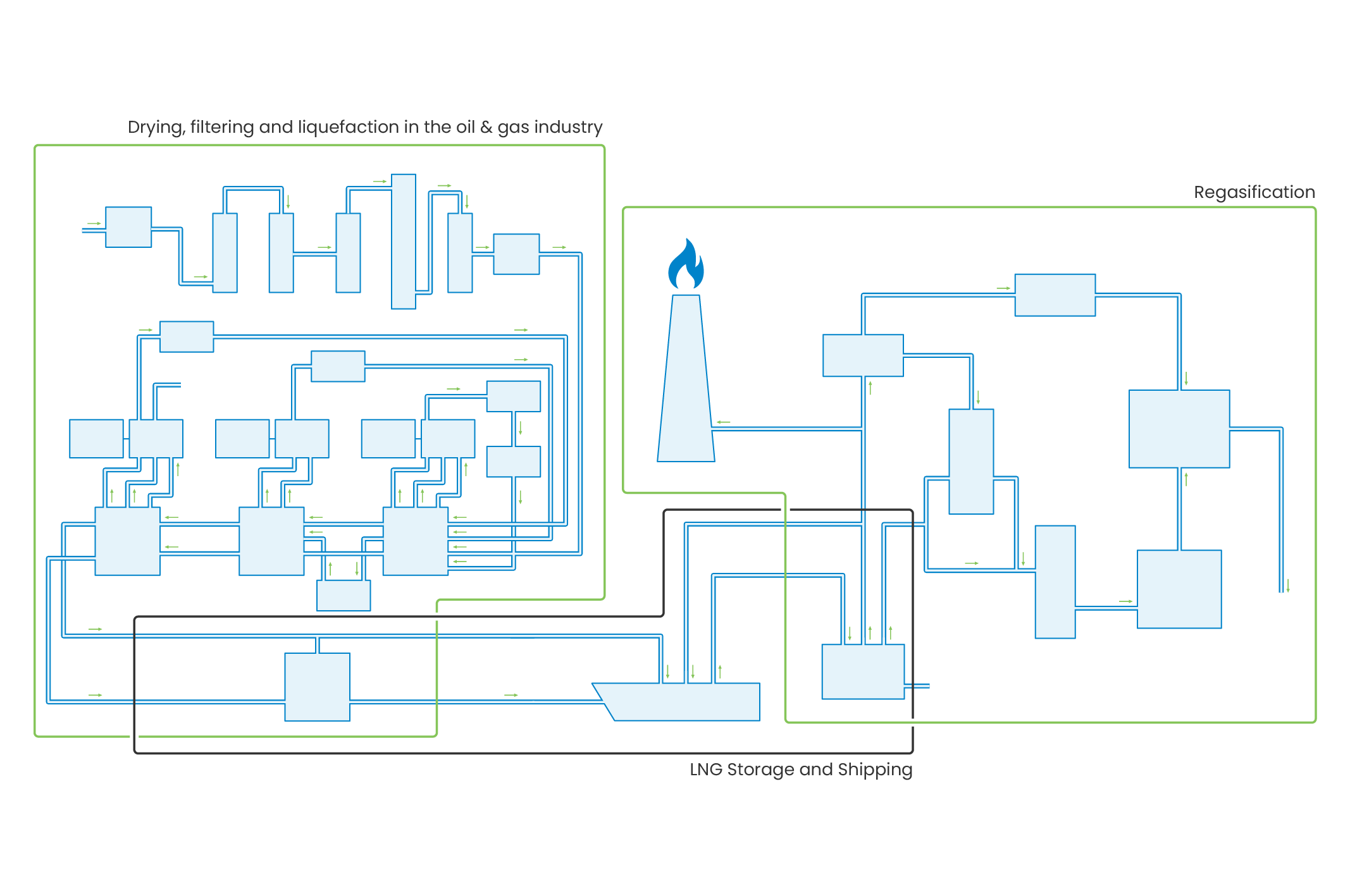
Natural gas is commonly transported over long distances through high-pressure transmission pipelines. When pipeline transport is not feasible due to technical, economic, or political constraints, the gas is transported by sea in the form of liquefied natural gas (LNG). To enable this, natural gas is cooled to approximately (–162 °C), at which point methane the primary component condenses into a liquid. Liquefaction reduces the gas volume by about 600 times, making long-distance storage and transportation significantly more efficient.
During transportation and storage, a small portion of LNG naturally vaporizes as boil-off gas, which is often used as fuel for LNG carriers. Accurate custody transfer measurement is therefore essential during LNG loading and unloading operations to ensure precise quantity accounting. LNG is composed mainly of methane, with small amounts of heavier hydrocarbons that vary depending on the gas source. These components influence properties such as density and calorific value and are largely removed during gas treatment and purification to ensure compliance with pipeline and distribution standards after regasification.
The increased availability of LNG has supported the development of small-scale LNG supply systems, where LNG is used as a clean fuel for trucks and marine vessels. Accurate metering is required in these applications for delivery verification and invoicing. LNG competes with other alternative fuel options such as liquefied petroleum gas (LPG), which remains liquid at moderate pressures, and compressed natural gas (CNG), which is supplied as gaseous methane at high pressure, typically around 250 bar.
top
Inactive
Tailored analytical solutions
for Southeast Asia’s industries.
Inactive
Solving analytical challenges
in every industry,
every day.